
The Current Ohio County Most Wanted Reality
Ohio County has no public "Most Wanted" roster right now. Neither the Ohio County Sheriff's Office website nor the detention center publishes one. That means there is nothing to count. No update schedule, no photo policy, no reward program. A leftover file name in the site's code hints at an old "10 most wanted" page, but a stray artifact is not a live list. Hidden is not the same as gone. Active warrants for Ohio County still sit inside law enforcement and court systems built for officials, not casual browsing. Watch the sheriff's site and social feed for any future announcement, and move quickly when posts appear. Verify the account, the posting date, the issuing agency, and the contact instructions. Check that the notice is still live before acting on it.
What a Verified Wanted Notice Should Show
With no verified county list in place, treat the fields below as a checklist. They describe what a legitimate official notice should contain, not any page that exists today.
| Field | What to verify |
|---|---|
| Issuing agency | An Ohio County Sheriff, court, or other government source, rather than a copied logo. |
| Publication date | The date the agency posted or refreshed the notice; search-result order does not prove currency. |
| Identity details | Enough official detail to avoid confusing people with similar names, without republishing sensitive data. |
| Warrant basis | The agency's stated warrant or charge description, understood as an charge. |
| Photograph | The credited official source and date. Keep photos on the agency site; do not rehost them. |
| Safety flags | Only cautions written by the issuing agency; never create an unsupported warning. |
| Tip route | The current agency telephone number or form and any stated anonymity or reward terms. |
How to Read an Ohio County Wanted Notice
Verification takes patience when an official notice does appear. A screenshot can float around long after a warrant is served, recalled, or changed, especially one with no working agency link behind it.
- Open the notice from the sheriff, court, or another government domain rather than a repost.
- Record its publication date, issuing agency, and exact contact instructions.
- Check whether the original remains live and whether the agency posted a correction or update.
- Do not contact, follow, photograph, threaten, or try to detain the person.
- Send information only through the official route. Call 911 solely when danger is immediate.
- After an arrest, use the official roster and booking-record routes, then follow the court case. A roster entry still does not prove guilt.
A jail booking proves only one thing. Someone entered county custody. It does not prove which warrant caused it. The real trigger could be a new charge, another agency's detainer, or a court order. Sort out those distinctions with the responsible agency and the court record.
The Safe Ohio County Warrant Check
Kentucky runs a statewide eWarrants portal that covers Ohio County. Access is the catch. The screen serves authorized personnel, not public browsing. Never guess credentials or slip past the login wall. Never treat a people-search site as official confirmation of a warrant either. The Kentucky eWarrants login page makes that boundary plain the moment it loads.
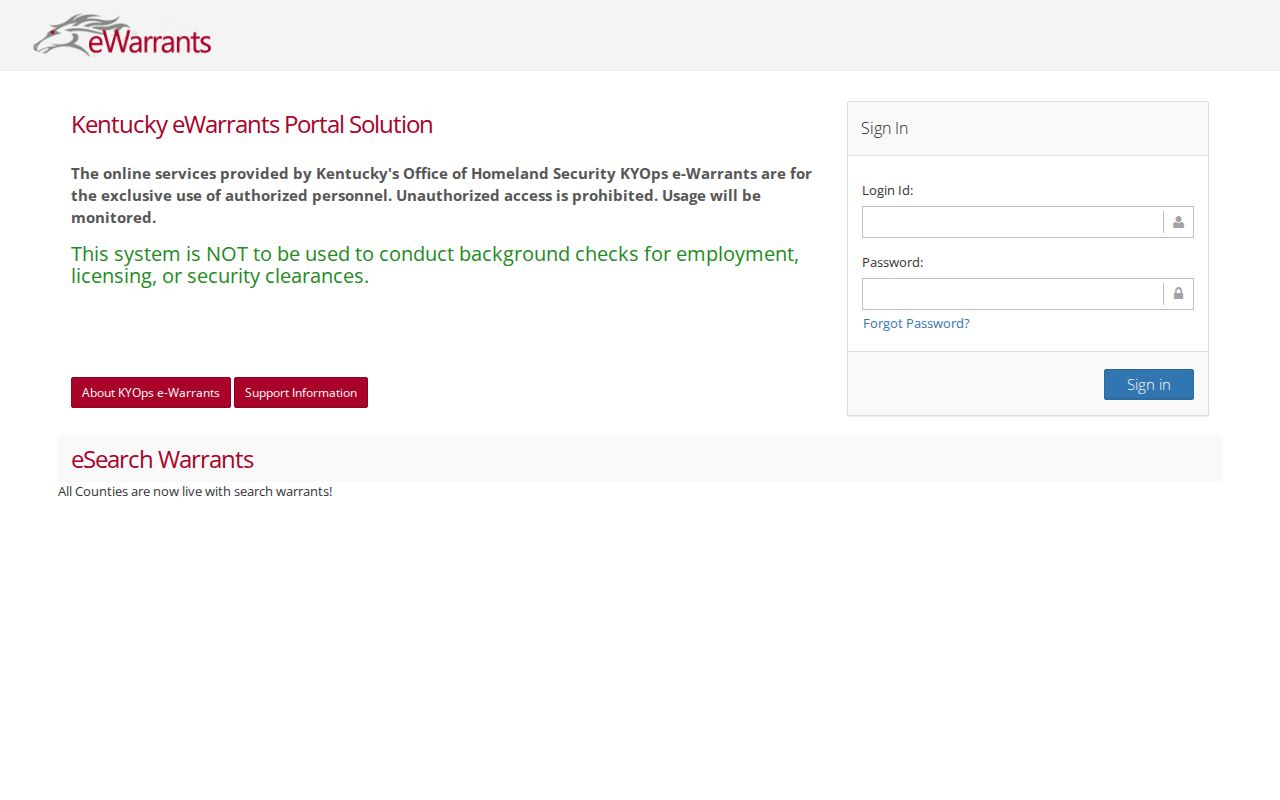
What the public gets from that system is proof it exists. Not a list of Ohio County names and warrant details. For a lawful check on your own situation, talk to an attorney. Or ask the Ohio County Circuit Clerk how to verify the matter. The Ohio County Court Information page lists the clerk at 130 East Washington Street, P.O. Box 67, Hartford, KY 42347, phone 270-298-3671. The clerk handles copies of Circuit, Family, District, and listed Business Court records, though staff may send an active-warrant question elsewhere. The Ohio County Sheriff's Office answers at 270-298-4444. Non-emergency dispatch is 270-298-4411. Dispatch keeps NCIC records, but that fact does not open NCIC to the public. It does not entitle anyone to another person's status over the phone. Save 911 for true emergencies, not research.
Tips, Safety, and Reward Claims
Ohio County offers no public tip form, no verified Crime Stoppers channel, and no reward policy tied to an official most-wanted list. Assume nothing you send by general message or social comment is anonymous. And never promise a reward unless a current official notice spells out the amount, eligibility rules, and claim process.
301 South Main Street, P.O. Box 186
Hartford, KY 42347
Office: 270-298-4444
Non-emergency dispatch: 270-298-4411
Emergency: 911
Wanted Lists, Warrants, and Bookings Differ
These three things get confused constantly. A most-wanted page is a curated publication. It highlights selected cases, not every active warrant. A warrant is court or law enforcement process that may never surface publicly. A booking record starts the moment someone is processed into custody. Each answers a different question, and each changes on its own clock. Stale unofficial entries leave out service, recall, dismissal, release, or final outcome. A current roster shows who sits in Ohio County custody at the moment you check. An older booking record documents an earlier intake. Neither settles the case the way the court file does. The Ohio County records guide walks through the live roster, the written-request fallback, and court follow-up. VINE, reached through the detention center's official VINE page, provides eligible custody and victim notifications. It is not a warrant search, a wanted list, or a photo archive. Not every event triggers an alert. The sheriff's Prepared Live system handles voluntary caller media and location for dispatch. It is neither a booking tool nor a warrant app.
When Warrant Records Disagree
When two sources clash, slow down. Note where each fact came from. Keep the warrant date, arrest date, booking date, article date, release date, and court outcome listed separately rather than lumped together. If an unofficial page contradicts the sheriff, jail, clerk, or court file, trust the official custodian. Ask which record actually answers your narrow question. A blank search result does not mean no warrant exists, and an online hit does not mean one is still active.
First figure out whether the sources describe the same event. A jail roster may reflect a current confinement while a docket covers an older case. A news story may describe conduct but leave out the warrant number. An aggregator can copy a charge label and skip a later release or amended count. Keep each source's own wording and date. Blending them creates a claim no official record supports.
Identity mismatches call for restraint. Similar names, misspellings, changed appearances, and copied photos can produce a damaging mix-up. Never use an unofficial photo to identify or confront someone. Give an official custodian only the identifiers it asks for. Never publish a birth date, address, workplace, family tie, or live location. If the agency cannot confirm the record, leave the question open rather than guessing.
Access is not interchangeable. The eWarrants login, dispatch's NCIC duties, a circuit-clerk file, and a jail booking each hold different material. Authorized systems can contain more than a public website displays. A clerk may route an active-warrant question to law enforcement. Dispatch may decline to discuss another person, and the jail may confirm only its own custody record. A referral or refusal is not evidence either way.
For a personal legal concern, a lawyer is the safest route, since counsel can deal with the court and agency directly. This is records-navigation information, not legal advice.
Which Ohio County Office Holds Which Record
Four related offices make up the local records system: the Ohio County Sheriff's Office, 911 Central Dispatch, the Circuit Clerk, and the Detention Center. Each holds different material. The sheriff is the official law-enforcement starting point and publishes the agency's contact details. Dispatch takes emergency and non-emergency calls and routes responders. It also maintains NCIC-related records, but those internal duties do not turn NCIC into a public database.
The Circuit Clerk is where case records begin for the county's Circuit, Family, and District Courts. A clerk file can show the case number, hearings, filed charges, and later disposition. It will not reveal how law enforcement plans to execute an active warrant. The detention center becomes the custody source once a person is booked there. Its roster can change after release, and it may not explain every warrant, hold, or detainer behind a confinement.
Ask a narrow question of the office that owns the record. Request a named court case or a booking from a stated date rather than every warrant or every inmate. Narrow requests cut down on identity mistakes. They also make it easier for a custodian to say whether a record exists, sits elsewhere, or is restricted.
If Ohio County Publishes a Future List
If a list shows up later, judge it from the source. Go to the original sheriff or issuing-agency page. Save that URL and the date you saw it. Then check the page itself for an update date, confirm each notice names the issuing agency, and make sure the contact route ends at an official phone number or form. Two posts a few days apart say nothing about a schedule. Photos deserve the same care. A government credit tells you where a news outlet got an image. That is all it tells you. It does not license a private gallery, and it does not prove the underlying case still stands. Keep the photo on the official page. If the agency pulls or revises a notice, let the old face and wording go with it. Before sharing a tip, look for an agency update. Warrants get served, recalled, superseded, or overtaken by court action. Follow any dedicated instruction on the notice exactly. Otherwise, use the sheriff's office or non-emergency dispatch. Never announce a person's location in a public comment thread. And never turn a records search into surveillance or confrontation.